BasicPlus
A general-purpose language for 32-bit microcontrollers: modern BASIC syntax, object orientation, a graphical interface and a first-class debugger. It compiles to bytecode that runs identically on the PC and on the micro.
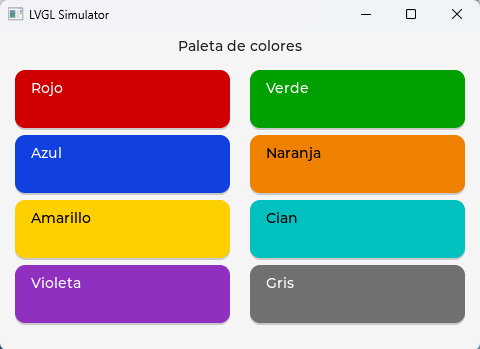
GuiColorDemo on a board — GUI with LVGL. The same bytecode runs on the PC and on the micro.
The same program you debug on your desktop later blinks an LED on a
Raspberry Pi Pico 2, an ESP32 (S3, C3, C5, C6 or P4) or an STM32 — no recompiling, no
#ifdef, no surprises. On a PC with no GPIO the hardware
builtins log to the console; on the board they drive real pins. The
bytecode is the same, byte for byte.
// blink.bp — blinks the Pico on-board LED (GP25) using the OO API.
module Blink
  import Gpio

  function Main()
    var led: Gpio.Pin := Gpio.Pin(25, Gpio.Pin.OUTPUT)
    var i: integer := 0
    while i < 100 do
      led.on()
      sleep(300)
      led.off()
      sleep(300)
      i := i + 1
    endwh
    print "Blink done"
  end Main
end Blink
And a micro does not only move pins: it also stores data. BasicPlus ships
SQLite — the same engine, the same .db file and the same code
on the PC and on the board, with the database on an SD card. You can write the SQL by hand
or let the ORM write it from your classes.
// Entities are annotated, and the compiler generates the DAO.
@BD{ tabla = "readings" }
public class Reading
  @BD{ pk }   public property id:    long
  @BD{}       public property value: double
end Reading

// ...and then, not one SQL statement in sight:
var w: Orm.Where := Orm.Where()
var cold: List := dao.list(w.lt("value", 22.0d))
The engine does not live inside the VM: it is burned separately, in a pack, so only those who use it pay for it — and it runs from flash without eating RAM. How it works, in full →
New in V8. This version brings three big things:
- WiFi and Bluetooth on the ESP32s with PSRAM — the S3, the C5 and the Waveshare P4, which carries its radio in its ESP32-C6: the board joins the network by itself at boot and the IDE works with it without a cable; from Bluetooth, for now, the keyboard and the mouse. Both radios are off by default, and switch themselves off after ten minutes unused.
- JC, a new language, a mix of Java and C# for those who work with those languages: without trying to be either of them, and with our own libraries. Inside it is BasicPlus, with the same compiler and the same bytecode, and a program is translated from one to the other from the IDE (the JC volume). To test it, Mono's C# test suite: of 2,322 tests, 848 run, and along the way both languages gained operators, interfaces and generics.
- Reliability. Four boards, 48 hours in a row with a program that touches everything, without a single error or restart, looking above all for any resource — memory — that might be slowly lost over time; the test found two real bugs, now fixed. Everything that is tested, in How BasicPlus is tested.
And also: what was pending from V7 and what came up along the way, fixed; strings, much faster (on the Pico 2, walking a 2 KB one went from 535 to 20 ms); sound on the Waveshare P4; and an image for the ESP32-P4X, the new revision of the P4, from the same code. Nine images for eleven boards. Details in the v8.0 release and the release notes (Spanish); what V7 brought — packs, one image per micro and the second core — is in the v7.0 release.
V8.1 changes nothing in the product: it reorganizes the project as a suite.
BasicPlus moves to the micro32-suite
organization, together with toolchain (the compiler, the IDE and the Java VM)
and runtime (the C VM and the firmware), each with its own history. The
download is now called Micro32-Suite-8.1-win.zip, in the
v8.1 release.
Getting started
The language and the tools
native (AOT) functions.
JC, BasicPlus with braces →
The Java and C# syntax on the same compiler and the same bytecode: each construct, in JC and in BP, and how to translate from one to the other.
Reference →
The complete standard library, the command line and the on-disk artifacts (.mod, .dbg, .pack…).
Graphical interface →
The Gui module: screen and widgets, layout, color and fonts, events and forms. Same bytecode on the PC and on the board.
Databases →
SQLite on the micro: the pack, plain SQL, @BD entities, the ORM with its generated DAOs, indexes and how not to eat your memory.
Packs →
Shipping a library in one piece and burning it onto the board: the two kinds, what goes inside, how it is used and the traps.
The SD card →
Gigabytes for your data: which families support it, how it is wired and configured, and how it is used — which is like any other path.
IDE guide →
The window, projects, Run/Stop, the board explorer, the micro console and the debugger.
Under the hood
Low-level specs (Spanish):
- →
.modformat — the bytecode binary spec. - → Opcodes — the semantics of all 189 instructions (plus a browsable view, partial: the V1 opcodes with their AOT translation).
- → Heap layout — the runtime
memory[]. - → Builtins — the
CALL_BUILTINcatalog. - → Wire protocol — the JSON-per-line PC↔board link.
Platforms
| Platform | Transport | Notes |
|---|---|---|
| PC (Windows/Linux/macOS) | — | Both VMs; TCP daemon for the IDE. |
| Raspberry Pi Pico 2 and Adafruit Metro RP2350 (Cortex-M33, dual core) | USB-CDC | A single image for both boards: the variant (A/B) is detected in hardware; board name and pins come from /sys/board.json; the Metro's PSRAM is enabled in the environment (psram=1). By default two BP threads run at once, one per core. AOT enabled. |
| ESP32-S3 (Xtensa LX7, dual core) | UART0 | Persistent FS on a dedicated partition; console over native USB. 8 MB PSRAM as the VM heap, and a pack area. By default two BP threads run at once, one per core. native runs interpreted (no AOT on Xtensa). |
| ESP32-C3 and ESP32-C6 (RISC-V without FPU, single core) — since V6 | USB-Serial-JTAG (the only USB) | Same ESP-IDF port; the console goes over UART0. No PSRAM: the VM gets up to 128 KB. The Waveshare C6 (ESP32-C6-LCD-1.3) has an SPI display, ST7789 240×240 with no touch, painted by the GuiMini and DriverSpi packs (with the Stdlib pack too, or the GUI doesn't fit). A pack area on both. AOT enabled since V7 (ilp32). |
| ESP32-C5 (RISC-V without FPU, single core) — new in V7, with a screen | USB-Serial-JTAG (the only USB) | The Waveshare ESP32-C5-Touch-LCD-2.8: 8 MB of PSRAM for the VM, 32 MB of flash, a TF slot and an ST7789 240×320 SPI display with touch, painted by the Gui and DriverSpi packs. The console goes over UART0. AOT enabled (ilp32). |
| ESP32-P4 (RISC-V, dual core) — with a screen | UART; on the P4X, USB-Serial-JTAG | LVGL GUI on a MIPI-DSI panel + touch: the panel driver comes in the image, LVGL in the Gui pack. A single image for the boards with revision v1.x of the chip, the Function-EV kit (EK79007 1024×600) and the Waveshare 4.3" (ST7701 480×800); the panel is chosen at runtime from the environment (display=st7701). Since V8, another one for v3.x, the ESP32-P4X (its Function-EV kit, with the same 7" panel), from the same code: the IDF does not let one image serve both revisions. By default two BP threads run at once, one per core. AOT enabled (RISC-V). |
| STM32 (Nucleo-U575ZI-Q · Discovery U5G9J-DK2) | ST-LINK VCP | FS in internal flash; AOT enabled (same Cortex-M33 as the RP2350). The Discovery DK2 adds an LTDC 800×480 screen + touch: the panel driver comes in the image, LVGL in the Gui pack. Adc works (ADC1, since V7); Wdt does not: its IWDG cannot be stopped once started. |
Nine images for eleven boards. A board with a screen needs, besides its image, the screen's
packs — burned from the IDE: Placa → Packs — and a RAM block for their
engine (packRam= in the environment): what to burn on each one, in
Installing the firmware.
On all of them: the cable has a system thread of its own, io, apart from the
program, so the board keeps answering the cable while the program runs — and, since V7, also
lists and reads files —; a "wire v1" REPL with file upload, remote RUN and a run argument
(run X <arg>), Stop (cooperative KILL without resetting the
board), autorun (/sys/auto.txt starts your program on power-up,
and the IDE can attach live), unified exit codes and on-device debugging with breakpoints
(while debugging, the program's threads take turns, as on a single core). On the dual-core
boards, vm.cores=1 and vm.runs=1 in the environment take the board
back to one core without reflashing.
Verified on real hardware
This is not desk theory: the full stack has been exercised on silicon. On a Raspberry Pi Pico 2 / Pico 2 W (RP2350) the whole hardware ladder was validated end to end — from the IDE, with Run on Device, running the same bytecode as on the PC:
| Subsystem | On-board test |
|---|---|
| Execution / OO | cross-module stdlib classes dispatching on the micro ✅ |
| GPIO | blinking LED (Gpio.Pin) ✅ |
| I2C | real BMP280 sensor (T/P) + bus scan ✅ |
| SPI | BME688 over SPI: chip_id + T/RH/P/gas reads with memory paging ✅ |
| UART | loopback, byte echo ✅ |
| PWM + counter | 1 kHz / 500 Hz counted in hardware, < 0.1 % error ✅ |
| ADC | chip internal temperature (23.9 °C) ✅ |
| RTC | monotonic clock + recalibration ✅ |
| Watchdog | feed / timeout / disable ✅ |
| Timers | hardware alarms (polling, synchronized, stopwatch) ✅ |
On the STM32 (Nucleo-U575ZI-Q) the four critical
buses were also validated on the board with real sensors: GPIO,
SPI (BME688), UART (loopback) and
I2C (BME280, T/P). And on the ESP32-S3
(DevKitC) those same four buses were validated on the
board with real sensors (BME688 over SPI, BME280 over I2C, GPIO and UART
loopbacks) — the three families are on par. On STM32 and
ESP32 the non-critical peripherals work too (PWM, ADC and RTC; the STM32's
external ADC since V7); the watchdog, on the ESP32s — the STM32 has none, on
purpose: its IWDG cannot be stopped once started. The Metro RP2350B
shares the firmware image with the Pico — one .uf2 for both, the
variant is detected at runtime. V6 added the ESP32-C3 and
ESP32-C6 (and the UART gained a 512-byte receive ring), V7 the
ESP32-C5 and V8 the ESP32-P4X. The V8 test round passed,
with the images being released, on all eleven boards and three
architectures: Pico 2, Metro, S3, C3, C5, C6, the three P4s (the Function-EV kit, the
Waveshare and the P4X kit), Nucleo and DK2.
Boards with a screen (since V3). The GUI (LVGL) has been verified on
hardware on all six: STM32U5G9J-DK2 (LTDC 800×480 + GT911 touch),
ESP32-P4-Function-EV (EK79007 1024×600), since V8 the
ESP32-P4X-Function-EV (the same panel),
Waveshare ESP32-P4 (ST7701 480×800),
Waveshare ESP32-C6-LCD-1.3 (ST7789 240×240 over SPI) and, since V7,
Waveshare ESP32-C5-Touch-LCD-2.8 (ST7789 240×320 over SPI + touch) — widget
catalogue, colour, .win forms, touch and screen capture (Gui.shot),
with the same bytecode on all of them. Since V7, with LVGL from a pack. The
program's screen is the size of the panel.
Credits
BasicPlus is a stack of its own from top to bottom — compiler, two virtual machines, IDE — but it is not built in a vacuum. The flash filesystem is littlefs; the graphical interface is LVGL, painting onto SDL2 on the PC; the VM’s tasks rest on the FreeRTOS RTOS; each micro boots with its manufacturer’s SDK — Pico SDK, ESP-IDF, STM32Cube; and the IDE edits with RSyntaxTextArea and talks to the board through PureJavaComm.
This project would not have been possible without them. They are all named, with what each one does inside and under which license, on the credits and acknowledgements page.
The name. BasicPlus is a homage to Digital Equipment Corporation's BASIC-PLUS, the structured dialect that ran under RSTS/E on the PDP-11s through the 70s and 80s — the BASIC whole systems were written in, and a generation learned to program with. The same idea (a language that is easy to read but doesn't treat you like a beginner) transplanted to today's small hardware.